Why your expertise does not speak for itself, and how to make complex ideas land.
How do you explain complex ideas clearly?
Experts often struggle to explain complex ideas because they communicate from inside their own context. Their audience cannot see the connections, priorities, and distinctions that have become automatic to them. To make expertise land, you need to orient the audience, choose the right level of detail, connect the insight to what matters, and give people language precise enough to think with you.
I call the result Visible Expertise.
Visible Expertise is the ability to translate deep knowledge so people without your context can understand the point, see its value, and use it.
2 different problems with the same cause
I once asked my audience what they most wanted to improve.
About half chose high-stakes speaking and thinking. The other half chose the same challenge with AI involved.
At first, those looked like two different needs. One group wanted to communicate better in the room. The other wanted to get better ideas and outputs from AI.
But the written responses kept pointing to the same underlying problem:
You have a lot of knowledge in your head. You know your subject. Yet when you speak, the insight does not land. When you use AI, the depth of what you know does not make it into the final output either.
The missing skill is translation.
We assume that because we know something deeply, it should come out naturally and other people should get it. But your expertise contains years of accumulated context. The audience receives only the words you choose in that moment.
That gap is where good ideas disappear.
Knowledge is not self-translating
Expertise changes what you notice.
You see patterns faster. You compress several observations into one concept. You know which exception matters and which detail can be ignored. You remember the five decisions that brought the project here, so the sixth decision feels obvious.
The person listening to you does not have that compressed history.
Researchers have documented one version of this problem as the curse of knowledge: once people possess information, they struggle to fully set it aside when estimating what someone with less information will understand.
In practical terms, experts can lose access to confusion.
This is why adding more information often does not solve the problem. You may be adding detail from inside the same context the audience does not have.
The audience does not need all your knowledge first. They need direction into it.
AI creates the same translation problem in a different form. Its output is shaped by the context, standards, and distinctions you make available. More output cannot reliably recover expertise that never made it into the prompt or process.
The Chunk Dial: 2 ways expertise becomes invisible
Complex explanations tend to fail at two opposite extremes.
At one end, the explanation is under-chunked. You provide details without first grouping them into a meaningful concept. The listener has to hold each fact separately and work out what they add up to.
At the other end, the explanation is over-chunked. You use concepts, abbreviations, or jargon that contain meaning for you but remain closed to the audience.
I think of this as a Chunk Dial.
Details without a concept lose people. A concept without details loses meaning.
The goal is not to eliminate detail or jargon. The goal is to move the dial to the level your audience can use.
When you are under-chunked, group the details
In consulting, we regularly conducted expert interviews to gather information for a project. When asked for an update, a typical recap sounded something like this:
“The interview went well. We went through most of the questions. There were a few the expert couldn't answer. I ran out of time near the end, but they also mentioned something interesting about...”
This is a detailed explanation of what happened. It is also not very useful.
The listener has to extract the status, finding, risk, and next step while the person is still talking.
A structured version might sound like this:
“We completed all 10 interviews. Most experts agreed that X is the key factor. A smaller group may be pointing to an emerging trend, so we're following up and should have a second insight by the end of the week.”
The details now sit inside three useful concepts:
Progress
Main finding
Emerging signal and next step
Nothing was dumbed down. The meaning became visible.
If people tell you that you ramble, ask:
What single concept could hold these details together?
When you are over-chunked, unpack the concept
During my first week at Google, it felt like everything had an abbreviation. Meetings were filled with names for internal tools, processes, teams, and metrics. Everyone else shared the vocabulary, so they could think efficiently in shorthand. I was trying to decode the language while keeping up with the actual discussion.
The fix did not require a glossary or a 10-minute detour. Often, one short phrase would have been enough:
“We use OKRs. Think of them as goals for now.”
The phrase “for now” matters.
It signals that there is more nuance, but we do not need all of it yet. This is not pretending OKRs and goals are identical. It is giving someone a foothold so they can keep thinking with the room.
Jargon is not the enemy. Among peers, shared language is efficient. The failure is assuming the audience shares your definition when they do not.
If people look confused even though your explanation sounds concise, ask:
Would they recognize this term without my context?
Give people the map before the terrain
Even the right amount of detail can fail when the audience does not know where it belongs.
Experts often communicate from inside their own timeline. They jump into the current problem because they remember every phase that led to it. To everyone else, the information arrives without an arc. Every detail sounds equally urgent and unconnected.
Phase Framing solves this by locating the audience in a larger sequence:
Where are we now?
Where did we come from?
Why does this phase follow from the last one?
What comes next?
For example:
“We're in validation. Discovery confirmed that the problem exists, so now we're testing whether our proposed solution solves it. Three tests are running this week. Depending on the results, we'll either move into build or reframe the solution.”
That explanation contains context, logic, scope, and the next decision. It does not force the audience through the entire project history.
The same structure can be compressed on the spot:
“We're in validation. Discovery confirmed the problem, and now we're testing the solution.”
When you can name the current phase, you make your own position clearer. More importantly, your audience can locate themselves too.
Before you explain the work, ask:
What does this person need to know about where we are before the details will make sense?
Zoom out without diluting your insight
There is another reason analytical people struggle to “get to the point.”
It is often not that they lack a point. They have zoomed in so far that no one else can see how the point fits into the bigger picture.
I understood this more clearly while walking through a Monet exhibition in Tokyo.
When you stand too close to an oil painting, individual strokes can look disconnected. A white mark is just a white mark. Step back, and those same white marks make the whole painting shimmer. Their meaning comes from their relationship to the whole.
Details work the same way.
Your analysis may be rigorous. Your observation may be the one thing everyone else missed. But if you do not articulate where it fits, the room experiences it as another detail.
So “get to the point” often means:
Zoom out and show me why this detail changes the picture.
This does not mean making the point you think executives want to hear. In one of Monet's Parliament paintings, the building was prominent, but what drew my attention was the effect of light and fog. That observation became the focus.
Analytical thinkers should do the same. Your value may be noticing an effect, risk, or relationship that others missed. Keep the insight. Translate its consequence.
A simple check is:
What am I seeing?
Why is it happening?
So what changes because of it?
The “so what” is not decoration at the end. It is the bridge between your detail and the audience's decision.
A 4-pass Visible Expertise check
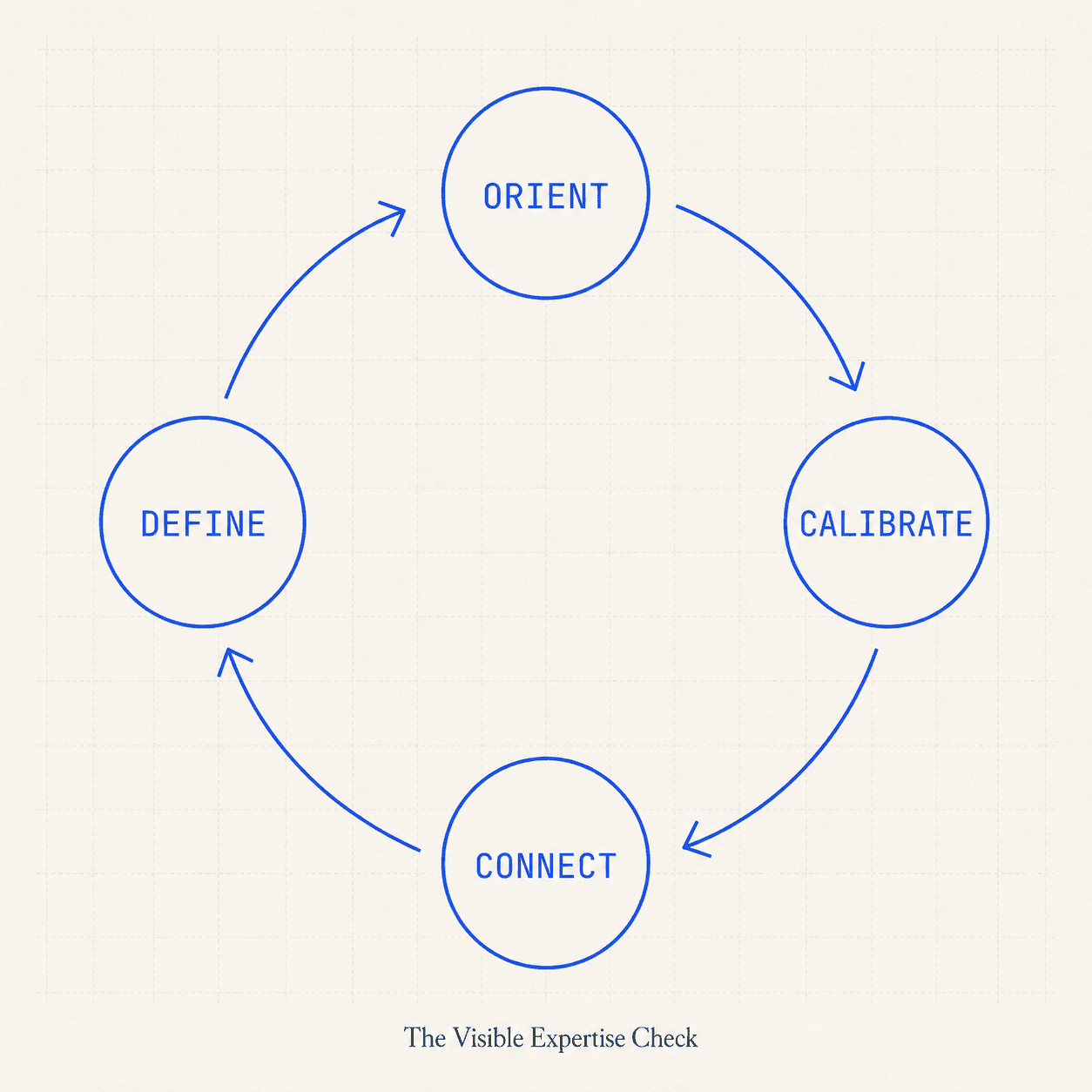
Here is one way to apply the ideas in this article. Before your next presentation, update, article, or AI prompt, make 4 passes.
1. Orient
Can the audience tell where we are and what this communication is for?
Give them the phase, question, or decision before the backstory.
2. Calibrate
Is the explanation under-chunked or over-chunked?
Group details when the audience is drowning in them. Unpack concepts when your shorthand excludes them.
3. Connect
Have you shown how the insight affects the goal, decision, risk, or next step?
Do not remove the detail that makes your thinking valuable. Show its relationship to the whole.
4. Define
Do you share language precise enough to discuss and act on the idea?
Name the useful distinction. Explain it once. Then let the shared language make the next conversation sharper.
Common mistakes when simplifying expertise
Removing the nuance. Simplification is not deleting everything interesting. It is sequencing complexity so the audience can enter it.
Giving the entire backstory. Context is not a history lesson. Often, the previous phase and the current question are enough.
Eliminating all jargon. Shared shorthand is useful. Define it for people who are not yet inside it, then use it.
Expertise is what you know. Visible expertise is what others can use.
Your knowledge does not become less sophisticated when more people understand it.
The real loss happens when years of context, pattern recognition, and judgment remain trapped inside your head because no one else can find a way in.
You have already done the hard work of building the expertise.
The next skill is making the room feel it.
Your move: take your next update and run it through the 4 passes. What does the room need before the details?
Go deeper
Explore the course: Drowning in complexity? Complexity to Clarity gives you practical frameworks to build mental models, make sense of ambiguity, and communicate clearly to others.
Speak with frameworks
Get weekly frameworks to upgrade your mental OS