short answer
To stop rambling and speak clearly at work, give your thoughts a simple structure before you explain them. Start with the one thing people need to know, add depth with a three-line structure, then sharpen the idea by naming what it is not.
watch the video
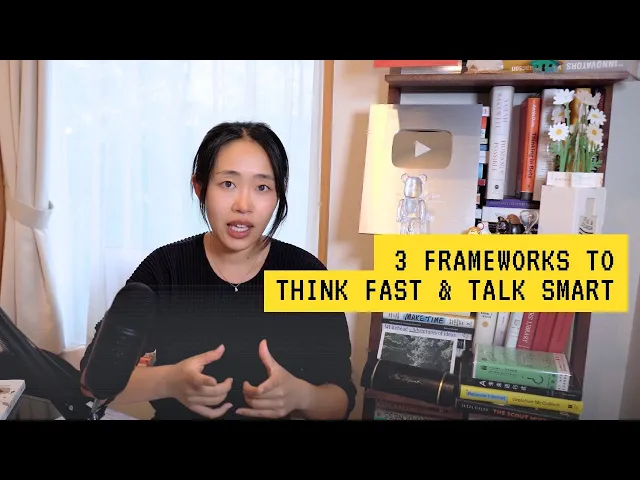
This article is adapted from my video, 3 Simple Ways to Make Clear & Concise Points | Stop Rambling!. Watch the video if you want to hear the examples in context, then use this page as the skimmable version before your next meeting.
resources
If your ideas are strong but they come out scattered, 5-Minute Communication Frameworks gives you plug-and-play structures for making clear, concise points at work.
Want one clear-thinking idea in your inbox each week? Join the Speak with Frameworks newsletter for practical ways to think fast, speak smart, and upgrade your mental OS.
the 10-second version
framework | what it does | use this when | example
|
|---|---|---|---|
The one thing | Forces you to find the point before the details | You are tempted to start with background | “The one thing you need to know about this campaign is that it worked.” |
Three-line scene | Gives your point a beginning, middle, and next step | You need to explain without drifting | “What I mean by worked is customers shared it voluntarily.” |
Via negativa | Makes vague ideas more specific by naming what they are not | You cannot quite articulate the insight yet | “The success did not come from people loving the product. It came from the easy gifting process.” |
the real problem
Rambling usually feels like a personality flaw.
You are in a meeting. Someone asks for your take. You start talking, then suddenly you are walking people through the whole history of the project: the early options, the cross-functional discussion, the research, the caveats, the thing someone said three months ago, and the detail that might matter but maybe does not.
Ten minutes later, people still do not know what is happening.
The real problem is that thoughts do not naturally arrive as clear sentences. In the video, I describe thoughts as “nebulous blobs of electric signals.” When you speak, there is a translation process: you are taking something fuzzy in your head and turning it into language in real time.
That is already hard. Under pressure, it becomes even harder.
What people miss is that clear speakers are not magically thinking in perfect paragraphs. They have ways to guide the translation process. They know how to find the point, add structure, and bring specificity before the listener gets lost.
Use these 3 moves:
Find the one thing.
Build a three-line scene.
Sharpen with via negativa.
step 1: find the one thing
The fastest way to stop rambling is to use the word one.
Try this sentence:
That sentence is simple, almost annoyingly simple. That is why it works.
It forces your brain to choose. Instead of opening every drawer in your mind at once, you give the listener one door to walk through.
For example, instead of starting like this:
Start like this:
Is that the most brilliant point in the world? No. But it is already much clearer than a chronological tour of every thought you had along the way.
It gives people direction.
Then, as you speak, you can refine it:
Your first point does not have to be set in stone. You can refine it while you talk. The goal is to give yourself and the listener a starting place.
That alone makes you clearer than the person who begins with “let me walk you through the background” and never quite arrives.
step 2: build a three-line scene
Once you have the point, you still need structure.
This is where improv helps. In the video, I use a framework from improv called a three-line scene. The idea is simple: a good scene needs enough structure for people to know where they are, why it matters, and what happens next.
Your work update needs the same thing.
Use three lines:
Set the scene.
Add depth.
Say what is next
line 1: set the scene
The first line is the point from step 1:
Now everyone knows the topic and the direction. They are not trying to reverse-engineer your point from the evidence.
line 2: add depth
Depth can come from explanation or surprise.
Use explanation when the point needs clarity:
Use surprise when the listener needs to pay attention:
Both versions keep you from staying on the surface. You are not just saying “it worked.” You are showing what kind of success you mean.
line 3: say what is next
The third line either opens the conversation with a question or closes it with an answer.
Open with a question when you need discussion:
Close with an answer when you have a recommendation:
Now you have a complete thought:
That is clear enough for a meeting. It has a point, a useful detail, and a next step.
step 3: sharpen with via negativa
The last reason people ramble is that the idea is still too vague.
You can have a point and a structure, but if the words are broad, the listener still has to do too much work.
This is where via negativa helps.
Via negativa means understanding something by naming what it is not. Sometimes it is difficult to say exactly what something is, but much easier to say what it is not.
For example:
At work, the same move helps you turn a vague point into a sharper one.
Vague:
Sharper:
That distinction changes the recommendation.
If people loved the product, you might make more of the same product. If people loved the gifting process, you might create more giftable options and keep the buying experience easy.
That is the difference between sounding confident and being useful.
Specificity is not decoration. It helps people understand what decision follows from your point.
try this before your next meeting
Use this 5-minute prep before you speak:
Here is the same structure in practice:
You can use this before a meeting, a manager update, a presentation, or a difficult conversation where you are afraid your thoughts will spill out in the wrong order.
The point is not to sound scripted. The point is to give your thinking a track to run on.
common mistakes
Starting with the full backstory instead of the point.
Treating “clear” as the same thing as “short.”
Naming the point once, then drifting into a stream of consciousness.
Using examples that are detailed but not specific.
Ending without a question, recommendation, or next step.
🧪 why this framework
This framework works because it reduces the mental load of speaking.
When you are asked to explain something on the spot, your brain has to do several jobs at once: find the idea, choose the words, sequence the details, read the room, and decide what to say next. Cognitive load theory is often used in learning design to explain why people perform better when information is structured in ways that reduce unnecessary processing. See this overview of cognitive load and worked examples: The influence of the order and congruency of correct and erroneous worked examples on learning and cognitive load.
The “one thing” sentence lowers the decision load. The three-line scene gives your thought an order. Via negativa gives your brain an easier path into specificity when the positive definition is still fuzzy.
The practical implication: do not wait for your thoughts to become clear on their own. Give them a small structure, then speak into it.
if you enjoyed this…
You might also like: How to Think Fast Before You Speak: Framework Thinking
Speak with frameworks
Get weekly frameworks to upgrade your mental OS