Mastering Smart Note-Taking: Overcoming the Illusion of Competence
Jan 20, 2025

Understanding the Illusion of Competence
The illusion of competence. Why can't I explain what I just learned?
Have you ever delved into a book brimming with actionable insights, highlighting and underlining key points, only to find yourself at a loss when trying to relay this newfound knowledge to others? This phenomenon, often accompanied by a frustrating pause and a struggle to recall specific ideas, is known as the illusion of competence.
This experience is common and can happen just minutes after reading. You may find yourself eager to share the fascinating concepts with friends or family, only to realize that you can't quite articulate what you've learned. The illusion of competence is a deceptive feeling where we believe we have understood something when, in reality, our grasp of the material is superficial
This section delves into why this occurs and how traditional note-taking methods may contribute to this false sense of understanding.
The Power of Smart Notes
In a world filled with distractions and superficial learning, the concept of smart notes stands out as a beacon for genuine intellectual engagement. The traditional methods of underlining and highlighting might give us the comforting illusion of learning, but in reality, our brains are often as inactive as a potato lounging on a couch. To truly engage with new information and ensure it sticks, we must adopt the method of smart notes.
Smart notes are not just any type of notes; they are the kind that legendary thinkers like Leonardo da Vinci and Nicholas Luhmann used to fuel their prolific outputs. Leonardo da Vinci, known for his contributions to fields as diverse as astronomy, civil engineering, and zoology, while also creating masterpieces like "The Last Supper" and "Mona Lisa," relied on this method to organize his thoughts and discoveries.
Nicholas Luhmann also used smart notes.
Similarly, Nicholas Luhmann utilized smart notes to produce an astonishing body of work. Over his lifetime, he published more than seventy books and nearly four hundred articles covering a wide array of subjects including economy, law, politics, art, religion, media—even love.
The power of smart notes lies in their ability to transform passive learning into active engagement. By distilling information into concise insights that can be easily connected with other ideas, learners can enhance their understanding and retention. Whether your goal is to become a more powerful thinker or simply to retain what you’ve learned more effectively, smart notes offer an invaluable tool.

Active Engagement with Smart Notes
Active engagement with smart notes is a transformative approach to learning and information retention. Unlike passive highlights and underlines that merely follow an author's flow of thought, smart notes require active restructuring of information into your own cognitive framework. This process is not just about absorbing information but about making it your own.
Smart notes are active, meaning that they're not passive highlights.
Smart Notes as Active Learning Tools
The essence of smart notes lies in their active nature. Instead of merely capturing information as it is presented, they challenge you to rethink and reframe the content in a way that fits into your personal understanding. This active engagement means you are not just a passive recipient of information.
Restructuring Thoughts into Personal Frameworks
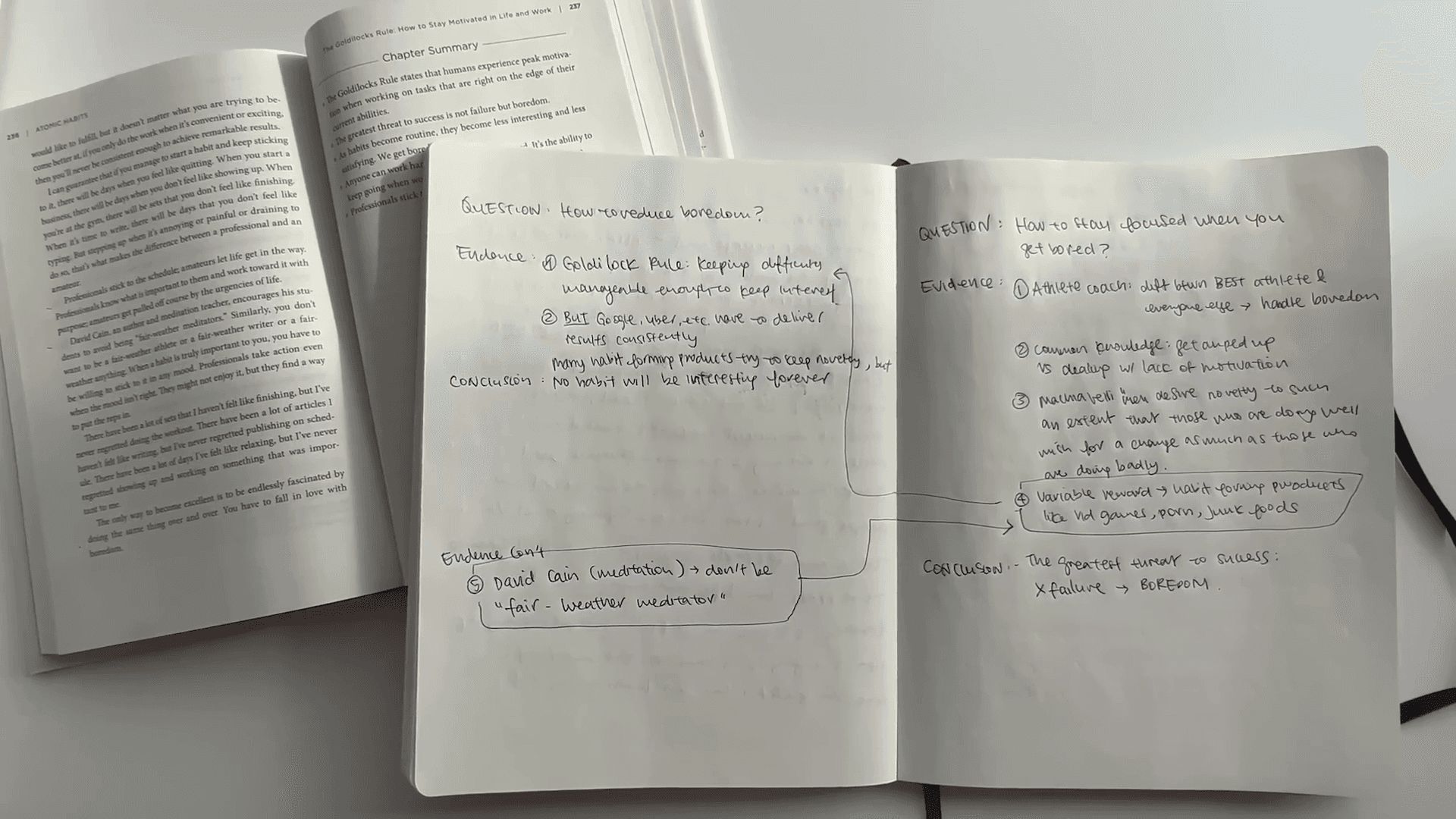
To effectively use smart notes, you need a personal framework to organize the information. If you don't have one yet, the QEC method is a great starting point. QEC stands for Question, Evidence, and Conclusion—a method that encourages critical thinking by focusing on these three aspects.
Introduction to the QEC Method
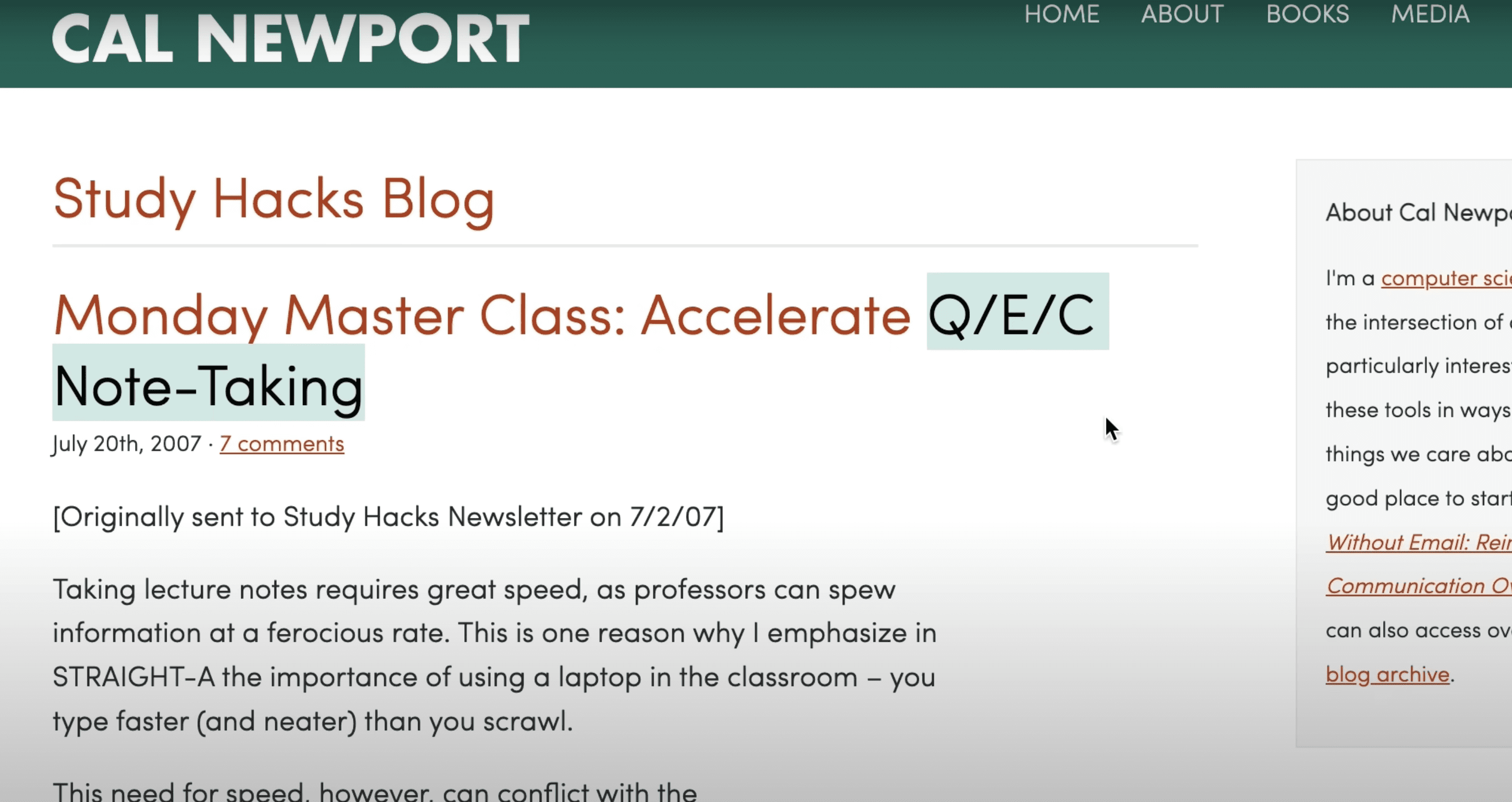
The QEC method, popularized by Cal Newport from Georgetown University, is an effective way to structure your notes. Newport, known for his work on deep work and productivity, emphasizes the utility of this method not only in academic settings like law school but also in various fields requiring critical analysis.
The QEC approach involves focusing on three key elements:
Question: What is the central question or problem being addressed?
Evidence: What evidence or data supports this?
Conclusion: What conclusions can be drawn from this evidence?
This method helps in distilling complex ideas into manageable pieces, fostering a deeper understanding and retention of the material.
Implementing the QEC Method
Implementing the QEC (Question, Evidence, Conclusion) method is a powerful way to enhance your reading comprehension and retention. This technique allows you to extract the most valuable insights from any text by focusing on three key elements: questions, evidence, and conclusions. Let’s dive into how you can apply this method effectively.
Steps to Apply the QEC Method
Identify Key Elements While Reading
As you read, search for the questions, evidence, and conclusions within the text. Regardless of how the author structures their work, you can consistently identify these three components and interconnect them.
Marking System
Professor Newport suggests a straightforward system for marking your text while reading:
Place a dot next to any conclusions or key ideas.
Use a dash across any evidence or examples provided.
Review and Synthesize
After reading, review your notes and consider which questions your identified ideas address. Determine how these ideas align with the evidence you noted.
Example with 'Atomic Habits'
To illustrate this method, consider "Atomic Habits" by James Clear. Clear’s writing style is very direct; many of his chapter headings are posed as questions. As you read through a section:
Place a dot next to new ideas that are introduced.
Use a dash across examples or anecdotes that illustrate these ideas.
Once you've finished reading a section, organize your notes by starting with the question, followed by the evidence you've gathered, and conclude with summarizing insights.
"You look for only three things when you're reading, the questions, the evidence, and the conclusion."
Using this approach transforms reading into an active engagement task rather than passive consumption. It enhances understanding and makes recall more efficient when revisiting your notes later on.
The Importance of Atomic Notes
In the realm of note-taking, many people stop at simply having a question, evidence, and a conclusion. They think, "What more do I need?" However, to truly excel and outsmart others, the concept of atomic notes becomes crucial.
"The next thing about smart notes is that they are atomic."
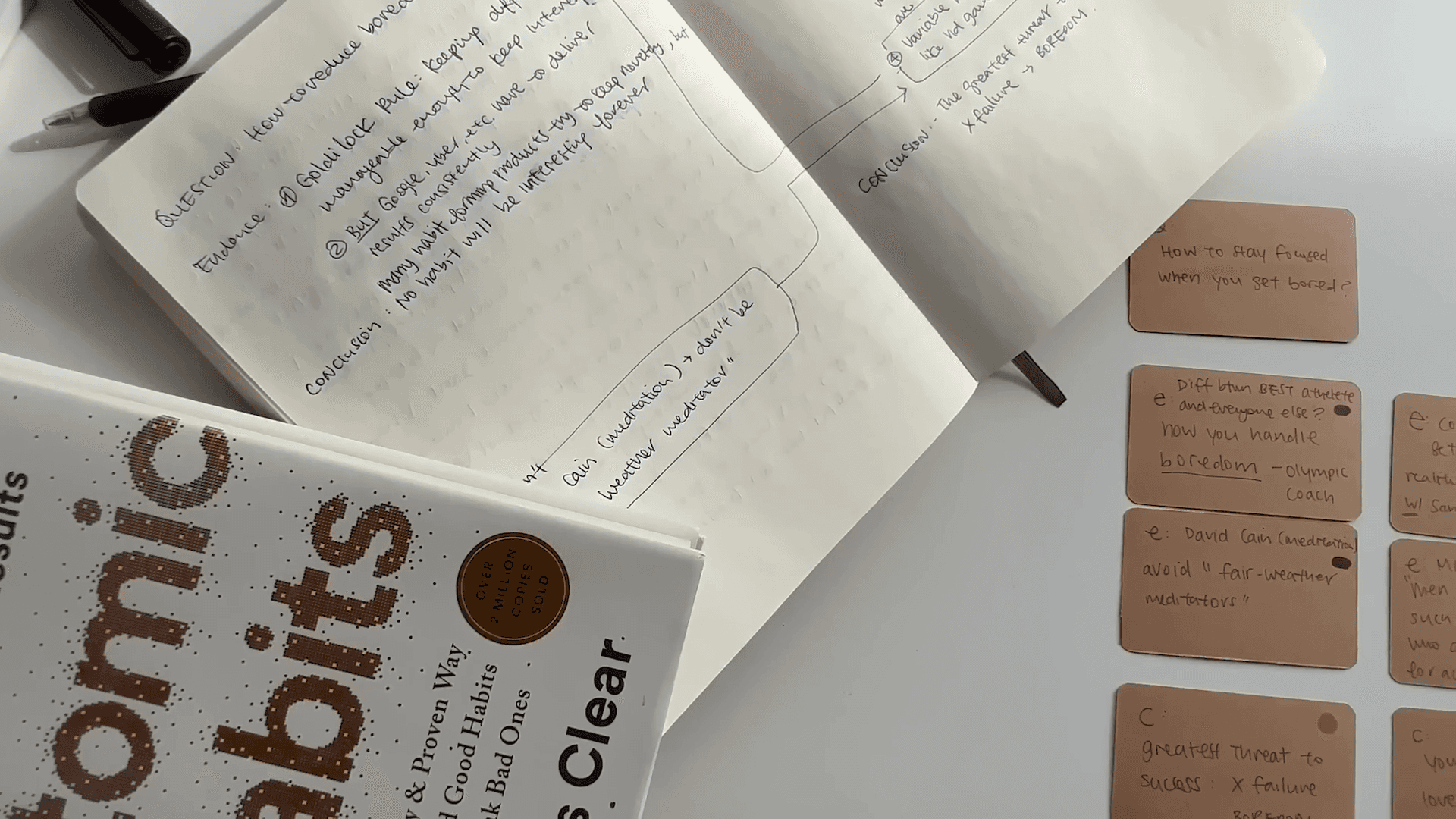
The size and structure of your notes significantly impact your thinking process. While others may organize their thoughts into one massive document—be it a digital file or a traditional notebook—atomic notes take a different approach.
What Are Atomic Notes?
Atomic notes are small, self-contained units of information. Instead of compiling everything into one giant document, each idea exists independently. This method allows for more dynamic thinking.
Advantages Over Traditional Note Organization
Using large documents often leads to vertical and chronological thinking—A follows B follows C. If parts of that sequence are removed or forgotten, the whole structure can collapse. However, with atomic notes, each idea stands alone.
This independence allows for three-dimensional thinking: up and down, left to right, or even diagonally. You can compare different piles of ideas and see connections that might not be apparent in a linear document.
Charlie Munger's Perspective on Knowledge
Charlie Munger emphasized:
"The first rule is that you can't really know anything if you just remember isolated facts." When facts are isolated without being connected through a theoretical framework or "lattice work," they lose their utility.
By organizing ideas atomically and connecting them meaningfully, you allow your thoughts to "come alive," as Munger suggests. This approach not only aids in memory retention but also enhances creativity and problem-solving skills.
Connecting Ideas with Zettelkasten
In the realm of smart note-taking, the Zettelkasten method stands out for its emphasis on connectivity. As you create your QECs—questions, evidence, and conclusions—ensuring each one is its own atomic note is crucial. This atomicity allows you to rearrange and connect ideas more fluidly, enhancing the intelligence of your notes.
The third thing that makes smart notes smart is that they are connected.
The Zettelkasten method not only involves connecting ideas through QECs but also focuses on linking new insights to existing knowledge. This approach helps counter the illusion of competence by ensuring that new ideas are anchored to what you already know.
A practical way to visualize these connections is through the "compass of Zettelkasten thinking," a concept shared by my friend Faye. This involves placing an idea at the center and exploring it in four directions:
North: Where does this idea originate?
West: What ideas are similar?
East: What ideas compete with it?
South: Where can this idea lead next?
For instance, consider a concept from "Atomic Habits":
You do not rise to the level of your goals. You fall to the level of your systems.
Using this as a central idea, we can apply the compass approach:
North: This idea comes from goal-oriented thinking prevalent among us. However, as James Clear points out, both winners and losers share similar goals; it's their systems that differentiate outcomes.
West: Systems thinking aligns closely with this concept, emphasizing troubleshooting and process over mere goal setting.
This method encourages a deeper exploration and understanding of ideas by examining their origins, similarities, competition, and potential future pathways.
Expanding Ideas with the Compass of Zettelkasten
The Zettelkasten method acts like a compass, guiding us to explore ideas in multiple directions. This approach can be transformative, especially when applied to complex problems. By taking a single idea and examining it from four distinct perspectives, we can uncover innovative solutions to challenges like climate change and diversity issues.
You take one idea in the middle and you think in four different directions.
Using the Compass of Zettelkasten Thinking
The essence of Zettelkasten is about breaking down ideas into manageable pieces, allowing us to explore them from different angles. This method is not just about recording information but expanding our understanding by linking concepts in novel ways.
Exploring Ideas in Multiple Directions
Imagine you're managing a large organization or forming new habits. You can apply these principles by focusing on systems instead of just goals. As you think eastward, you might question what competes with this idea or what's missing. For instance, setting goals provides direction, but without the right systems in place, reaching them becomes elusive.
Application to Real-World Problems
Looking south, where do goals and systems take us? As highlighted by James Clear's insights on habits, it's crucial not only to form good habits but also to break bad ones. These principles extend beyond personal development into organizational contexts—helping break detrimental habits like those affecting diversity or environmental protection.
Just by thinking in four different directions, we're coming up with ways to solve climate change and diversity issues.
In conclusion, using the Zettelkasten method as a compass allows us to navigate complex ideas and find solutions that might otherwise remain hidden.
Mental reframe
Actionable frameworks content every week.
Subscribe (it’s free):